
How to Get Your Website Cited in Google AI Answers

A customer no longer has to open ten results and piece together an answer. Google can show a summary at the top of the results, together with websites where the customer can learn more. If your site is one of those sources, you can reach someone who is already looking for exactly what you offer. The good news is that you do not need a separate kind of „AI SEO“. Google says the same foundations still matter: useful content, a clear answer, an accessible page and proof that you know the subject. This guide explains how a small business can put those principles into practice.
Table of contents:
What changed in Google Search
Google now displays an AI Overview for some searches, a ready-made summary above or among the traditional results. Longer questions can also open AI Mode, where users can continue the conversation with follow-up questions. Both formats include links to websites that support the answer. In May 2026, Google said AI Mode had more than one billion monthly users and that query volume had doubled during the previous quarter (Google I/O 2026).
Traditional results have not disappeared. Customers can still open them, but an AI answer takes up a large part of the screen, especially on a phone. Ranking tenth is no longer the whole goal. Your page needs to answer a specific question clearly enough for Google to present it as a useful source.
In October, Google also changed the presentation of AI answers to make the source of each piece of information clearer. Links can appear next to the part they support, while some recommendations include a dedicated source list (Google, October 15, 2026). This gives a good business website a real opportunity: a useful answer can reach customers even when the publisher is not the largest site in its field.
Is there a separate AI SEO
There is no button for submitting a website to AI answers. There is also no special code that guarantees a citation. Google's official guidance says that the same foundations used for regular Search apply to AI Overviews and AI Mode, and that no special AI file or new structured data is required (Google Search Central).
Terms such as AEO and GEO may sound new, but the work behind them is familiar: learn what a customer asks, answer clearly, demonstrate experience and help the search engine understand the page. If your website already has solid technical SEO, it does not need to be rebuilt. The content that genuinely helps customers needs to become better.
| What matters | Why |
|---|---|
| The page can be opened and indexed | Google cannot use content that is blocked or has not been discovered |
| The answer is clear and complete | A specific passage is easier to connect to a specific question |
| You provide an original example or data | The page adds something beyond information copied from elsewhere |
| Headings and links describe the content | People and search engines can understand where each answer lives |
| The site works well on a phone | A visitor can read the answer and take the next step immediately |
What helps Google choose your website
Answer first, explain second
If the heading is „How long does it take to build a website?“, the first sentence should provide a realistic time range. Do not make the reader pass through five paragraphs about the history of the internet. After the short answer, explain what changes the timeline, add an example and cover the exceptions. That helps both the customer and the search engine.
Write from real experience
Google recommends people-first content with original information and clear evidence of experience (helpful content guidance). For an agency, that could be a before-and-after view, a number from a real project, a problem that appeared and the way it was solved. For a dentist, it could be a clear description of an appointment. For a store, it could be a comparison written by someone who actually used the products.
Cite sources when you make factual claims
The price of your own service does not need an outside source. A claim about a law, statistic or Google change does. Link directly to the institution, research or product owner, instead of a post that already summarized another post. Readers can check the fact for themselves, and your content no longer looks like a guess.
Connect pages that solve the same problem
A post about website speed should link to your SEO service, a relevant project and a detailed Core Web Vitals guide. A link such as „read the website speed guide“ is more useful than „click here“. Google recommends descriptive, technically crawlable links for the same reason (link best practices).
Keep the page technically sound
Every important page should have one clear main heading, an accurate title and description, a canonical URL, a good mobile layout and content that is not hidden from Google. Structured data can clarify that a page is an article, product or local business, but it must match what visitors can see. Fast, stable pages do not guarantee a citation, but they prevent visitors from leaving as soon as the page opens.
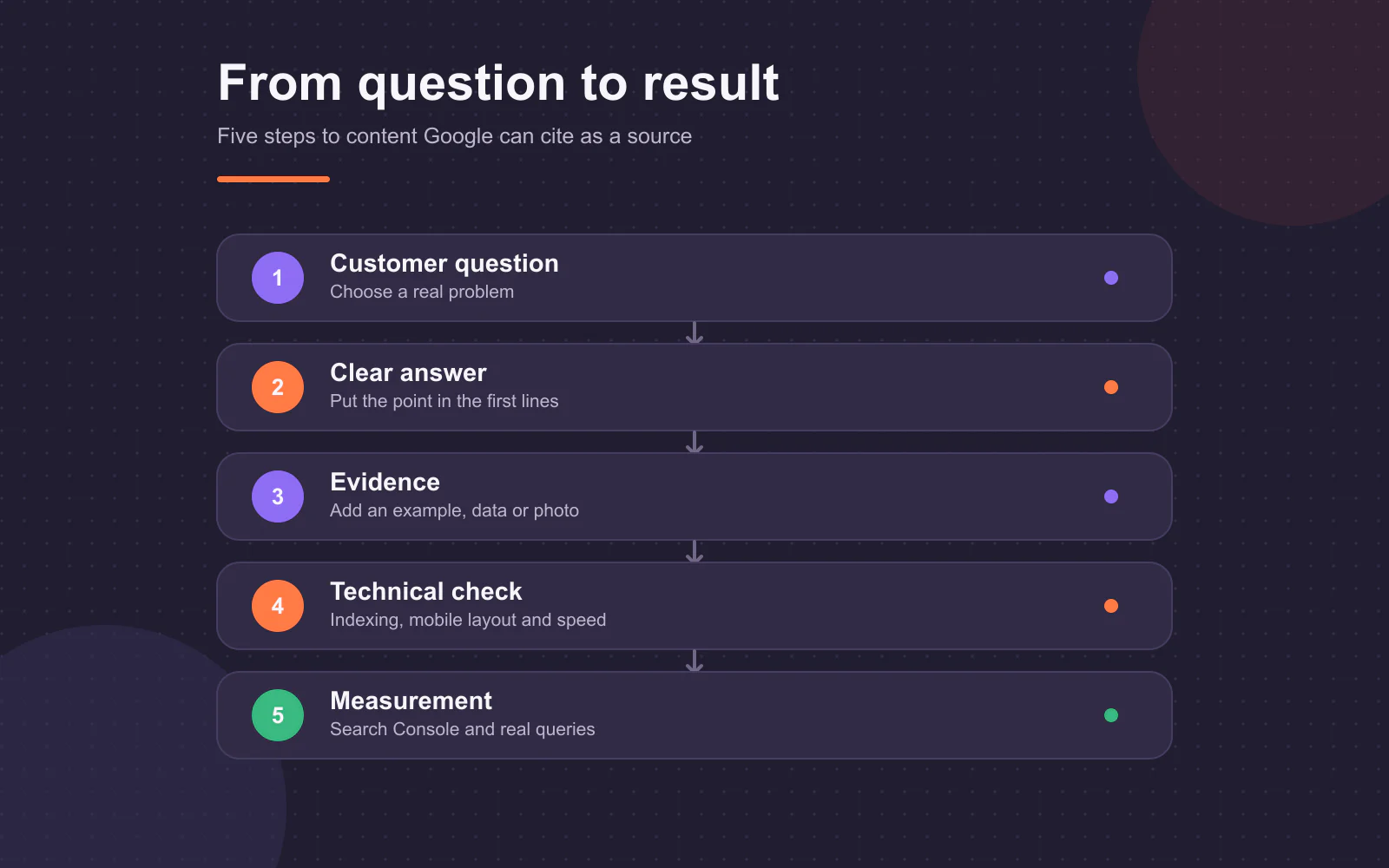
An eight-step process
- Choose one question customers actually ask before buying. „How much does it cost?“, „How long does it take?“, „What do I need?“ and „What is the difference?“ are useful starting points.
- Check the search results. Note what is unclear, out of date or missing a real example.
- Write a short answer directly below the heading. Two to four sentences should be enough to explain the essential point.
- Break the topic into subheadings that resemble customer questions. Each section should still make sense when read on its own.
- Add evidence from practice: a photo, result, calculation, table, process or mistake you have seen on a project.
- Link primary sources for factual claims, then connect the post to the right service and other useful pages on your site.
- Check the mobile layout, speed, page title, description and indexing rules. Request indexing in Search Console if the page is new.
- Track queries and impressions, then update the page when a new customer question appears or a fact becomes outdated. A useful guide is never finished forever.
The same process works for a new page and an older article that no longer attracts visits. Improving a strong existing guide is often faster than publishing another page that says the same thing.
A weak and a strong answer
Imagine a business owner searching for „How long does a business website take?“. This introduction does not help: „In today's digital world, a quality website is the key to success for every modern business.“ It could appear on a thousand websites, does not answer the question and proves no experience.
A stronger answer would be: „We usually complete a five-to-ten-page business website in three to six weeks. The timeline is shorter when the copy and photos are ready, and longer when the project includes multiple languages, a custom calculator or another system integration. On our last four projects of this kind, collecting content took more time than development.“
The second answer gives a timeframe immediately, explains the differences and includes a fact from experience. The customer gets useful information, while Google gets a clear passage that can be connected to the question. Your writing does not need to be literary. It needs to be specific and accurate.
How to measure the result
Search Console gained a dedicated generative AI report in 2026. It shows impressions and clicks from AI Overviews and AI Mode, together with the queries and pages that received them. Google said the report had become available worldwide by the end of August (Search Console announcement).
Do not look at clicks alone. Track whether an important page appears for more relevant questions, whether more of those visitors send an enquiry and whether the enquiries become better qualified. An AI answer may solve a simple question without a click, but a trusted source can still build recognition. The most important business measure is what a visitor does after reaching your website.
| Data | What it tells you | Next step |
|---|---|---|
| Queries in the AI report | Which questions Google connects with your content | Add a clear answer to a closely related question |
| Pages with impressions | Which content Google already finds useful | Refresh facts and add a stronger example |
| Clicks and engagement | Whether the title and content attract the right person | Improve the introduction and next step |
| Enquiries and sales | Whether the visit creates business | Connect the article to the right service and a clear call to action |
What does not help
- Hundreds of short AI-written posts with no first-hand example. Google allows AI as an aid for research and writing, but scaled pages with no added value can violate spam policies (Google guidance on generative AI content).
- Copying questions from a tool and repeating the same answer in different words. One complete page is often better than ten thin ones.
- Adding FAQ markup in code when the questions and answers are not visible on the page. Structured data must describe the real content.
- Buying a tool that promises a guaranteed place in an AI answer. No tool can guarantee that Google will choose a particular source.
- Hiding the key answer in an image or video with no text. Add a written explanation so people and search engines can access it.
- Publishing without an author, date or fact check. For changing topics, state when the information was checked and return to update it.
The most important rule is simple: do not create content for an imaginary robot. Write the best answer you can give a real customer, then make sure Google can find and understand it.
Frequently asked questions
Do I need a special llms.txt file?
Not for Google Search. Google says no new AI file or special markup is required. The page needs to be indexable and follow the usual Search rules.
Does Schema guarantee an AI citation?
No. Schema can clarify the type of content and the facts on a page, but it guarantees neither a traditional rich result nor an AI citation. Use only markup that accurately matches visible content.
How quickly can I see a result?
A new or changed page first needs to be discovered and processed. A change may appear within days, but weeks or months are common. Timing depends on the website, subject, competition and how often Google visits the page.
Can a small business appear next to a large publisher?
Yes, especially for a narrow question answered with better first-hand detail. A large site has authority, but a small business may have something the publisher lacks: a real price, a local process, a project photo or direct customer experience.
Should I rewrite every old blog post?
No. Start with posts that already receive impressions or support a service you want to sell more often. Add a clearer answer, a current fact, an original example and better internal links. Measure the result before moving to the next post.
In short
Getting cited in Google AI answers does not require a trick. It requires a page that gives an accurate answer quickly, demonstrates experience, cites reliable sources and remains technically accessible to Search. Choose one important customer question, create the best answer in your field and measure it in Search Console. If you want us to identify the pages with the strongest opportunity and improve them, explore our SEO service or send us a message.

 Let's talk about your project!